Saturday, August 17, 2013

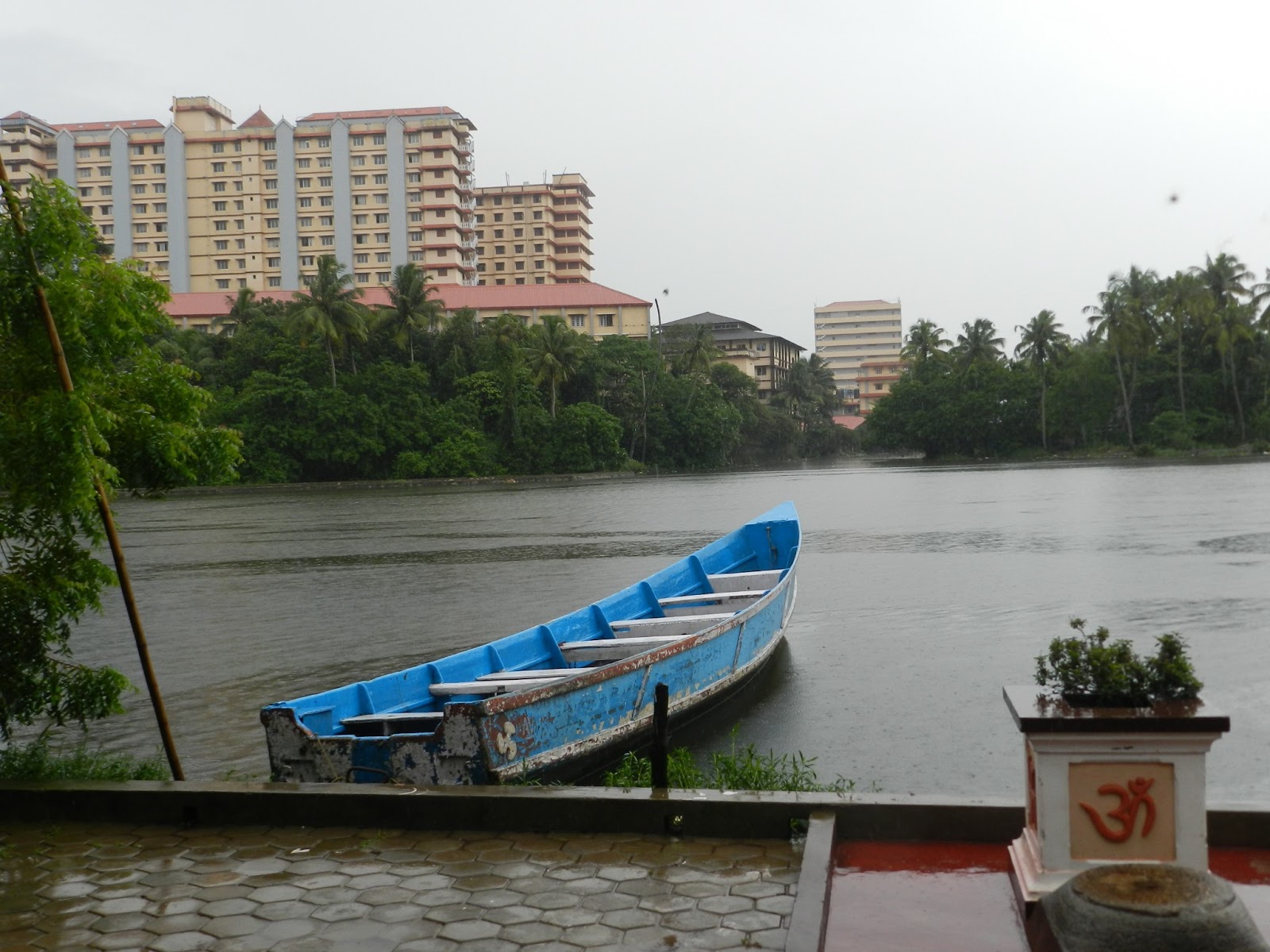
What a way to arrive in peaceful Auroville!!!

Well after a horribly hot night in the blue trains, I arrive very early in Pondychery, wander around the main bus station to find a bus heading towards Auroville… and land on the ECR at the rickshaw station.
Very sympathetic north indian students propose me to drop me at Central Guest house, which I accept.
But the auto taxi mafia pissed of to loose one customer start to buzz around us shouting, trying to take our keys.
I am exhausted and completely fed up with those guys.
I spot the leader and post myself in front of him, taking his finger down when he points at me.
After a few second of defying looks the guy gives the keys of the motorcycle back.
I realized later that after 2 or 3 of those little rickshaw drivers one of them would have managed to hit me in the back, and they could have hearted me really bad. But in the heat of the defying I did not think that far and just took a chance to let them know I was ready to fight.
What a way to land in peaceful Auroville!

Finally a nice room in Central Guest house: bamboos, flowers…

BioGas as a core solution to SWM plague?

Well that is the contention that Vivekananda organization took, especially in Kanyakumari: check the technical and implementation aspects, various home models as well as small communities ones: ww.vknardep.org/services/renewable-energy/technology/biogas-plant.html

Vasudevi and Ramakrishnan have been so kind to me when I came to visit them.
I had met Vasudevi one year ago in Amritapuri and we had discussed in situ various solutions that we were developing in the ashram as well as university side.

What an office: feels like it was designed and painted by Dali!


At the time Divine Mother was not very much in favor of my going and traveling to visit projects around India, or even to start pilots in neighboring villages.
This time, like a teenager running away from home, I did not ask for any body's permission, and I was enjoying total freedom in this spiritual/waste management trip in South India: Kanyakumari combining Biogas for village homes along with Vivekananda 150th Anniversary celebrations, Gandhi’s ashes in the 3 oceans, as well as the pleasure of steady heat, new landscapes and uses in Tamil Nadu.


Ramakrishnan took me on his motorbike to visit the training center used for external people, mostly giving them basis in Biogas implementation and maintenance.


What a great way to start the empirical part of the PhD, on a motorbike, with very open and kind village people.

Yet in terms of scale can man consider biogas a success with 3000 implementations over 25 years, 120 installations per year, a small village in India… every year.

I was left with mixed feelings.

Some mix of biogas and vermicompost in this home on the right

Of course Biogas was part of the solution, in villages as well as in cities… but definitely not THE solution.

How beautiful is this way of eating, which 10 years ago was still allowing everything to be thrown in the streets and recycled, or at least biodegraded.

Just as well as Shulab toilets had been a success in so far as people were using it (up to a few millions indians are using it now),  in so much as toilets was better than no toilets, defecation in the bushes, on the beaches…
So basically in the community engagement part Shulab had been a great success. But many experts, especially technical ones agree that the Shulab technology is not the best one if not a failure.
And Shulab Intl people seem to refuse to collaborate to improve these technical aspects that would make the Shulab toilets much more efficient and with greater impact, than the great political contacts that this organization has achieved in India, hence their high level of implementation.

So here is my opinion on how solutions in SWM could be mixed:
1st: better basic tech than high tech: cheap, easy to implement, to run, to maintain, scalable, replicable…
2nd: like in medicine: for many diseases, the best holistic approach should start with allopathy, then trying various holistic approaches: in my case Ayurveda worked miracles after clear diagnosis from Allopathy, and probably healed me of gal bladder pre-cancer
Just as well as sophrology was the best tool I found against stress.
But medication is as well compulsory in some cases and did save my life too.
Extremism in any of these approaches leads only to lack of openness and I believe, to failure.

So back to our case of SWM: lets consider SW as the illness or symptoms of modern society.

Allopathy could be the core municipality solutions: enforcement of SWM and segregation in homes, collections of segregated waste in situ (DtD at home/business/corporates/ hazardous waste like Medical waste…), sweeping streets, collection and disposal of waste according to their category, treatment of waste (recycling, composting, dumping, incineration…).
In each of these steps, processes we can introduce some degree of holistic approaches:
At the initial stage of waste generation: reduction of generation, lobbying against growing packaging, campaigns of awareness for segregation as well as cleaning in public space, CBO and NGO’s engagement to reduce and segregate waste, train their communities, informal sector especially for recycling helped and secured… organic composting for rural areas, outskirts of towns… individual biogas installations according to needs and size of homes, along with biomass plants for bigger organizations…


Here are the Chinese/Ayurveda/Acupuncture/Sophrology solutions that we can add to... lets say a 60% of municipal state allopathic therapy.

Saturday, July 27, 2013

And trying to keep on... reading...writing...

for academic articles:

1st one: 
Topic: Research Methodology
Title: Technological Innovation in Social Innovation (SI) context: specificities of pro-poor solutions from an Indian perspective
Abstract
Purpose – This study aims to investigate the relationship between High Tech and Low tech Innovation Processes in the context of Social Innovation (SI) with a particular focus on pro-poor innovations developed in India. After defining the factors that play a role in this interaction this study attempts to define a new way to look at social innovation especially in bottom up approaches that are way more qualitative and human resources focused.

2nd one:
Topic: New Institutional Economics
Title: Working title: Waste management and institutional perspectives with Indian empirical examples and theoretical economical approaches

Abstract:
Why waste needs institution or management?
Define the crux of the problem from market-failure perspective in waste creation.
What is the core of market failure in waste creation? Is the ill-defined property right or transaction cost or both, explain through review?
What kind of Institution or institutional response is required to address the market –failure issues in Waste creation? Explain different types of Institutions and institutional response from available case studies in India or elsewhere
Critically assess all types of Institutions and develop a matrix of performance of Institutions on several parameters of waste creation related problems

3rd article:
Topic: Advances Quantitative Methods
Title: Status of Waste Generation in urban India and key influencing factors e:
Abstract:
Very little has been written, published on waste management in India. Probably because little data are available.

Yet the topic of waste management in general and treatment of waste is becoming pivotal in a country that has an important growth rate, impacting hugely on the growth of its waste level and the problems of health, sanitary aspects, poor communities that come with it.

Tuesday, July 9, 2013

Where 3 oceans meet, where Gandhi's...

ashes where dispersed.
What a blessing to read Swami Vivekananda's sacred teachings from where his worldly mission started.

From where Gandhi decided to ...go.

Nerver mind failures... if you fail a thousand times, make the attempt once more!

So true, even when it stands in front of Men's room!

So... back on the road!
After a few days resting, under the rain, in Amritapuri, time for me to take my backpack again and head south, to the southern most point of India: Kanyakumari.


An early train, puffing its way between long coconut palms and flooded rice fields... actually quite refreshing in the hard sunlight getting high and hot by now ...
What a better way than these few kilometers where the landscape defiles slowly, to discover India from below the Line, from down under… from local projects as well as places of very high spiritual importance in India: Kanyakumari with Swami Vivekananda and Mahatma Gandhi, Pondichery and Sri Aurobindo and the Mother in Auroville a few kilometers north, Mahavalipuram and its sinked temples like an indian version of La Cite Perdue, Atlantide..

Tiruvanamalai and Ramana Raharshi, Arunachala and its 14 kilometers and mantra walk at full moon time… with thousands of pilgrims…

In the next weeks an introduction class on Social Innovation in IIT Madras the most famous Indian university, a bit like Polytechnique in France.

For now Kanyakumari welcomes me with a tropical dry heat, at the end of the end of India…
No more tracks after the train has stopped. Opening the door from AC 3rd tier, to get my throat assaulted by dry sandy air, smells of tropical islands (mix of frangipane and jasmine) as well as a weird kind of maqui smell too!
Memories of Corsica, of childhood islands, Guadeloupe, Tahiti, Rangiroa…
It is midday, the heat is culminating, and like in those island of my young age, siesta is not a luxury but a must!
No other choice than the touristic auto-rickshaw which charges 10 times more to get to Vivekananda ashram, usual tourist rape!
Ashram in the outskirts of town, beautiful campsite by the sea, with many temples, exhibition rooms for Vivekananda’s 150 bday!
Time to pay my respects to Mister Biogas here: his department has installed 3000 home units in the past 25 years.

And still no Pinkie Holding my dear friend Deepak, that will never happen!

But look at how happy they are: "
Hello you look lovely today... 
hey you what are you looking at!"
even sending bad looks and 'pinking' up a fight!!!

Monday, July 8, 2013

French man on a Dump Fill...in South India

...and a waste management trip!

From Coimbatore Velaloor dump fill to Kanyakumari, its Biogas plant in local villages houses... Pondichery, Auroville and its green experts, best practices... soon Chennai!

Looking at what exists in terms of waste management, meeting people...
http://articles.timesofindia.indiatimes.com/2013-07-02/coimbatore/40328551_1_vellalore-dumpyard-city-municipal-corporation-commissioner-waste

reading great Rishis and meditating in holy places

And if it inspired a few local people to get involved...all the better:

Dear Mr Guidi,
I read about you in Times of India , your work in south India.In my neighbourhood around 15-20 ton solid waste of all kinds is generated and being used for landfill.I have a dream that one day we should be able to recycle the same as manure for kitchen gardens and else where. inorganic are at present also segregated,plastics are also to some extent recycled but veggies n organics are also there...
I am a 55 yr year old mechanical engineer with very meager resources to live but i kbnow resources will pour in when we work for greater goodness of humanity...

Saturday, June 22, 2013

Monsoon, pissing rain in Kerala, tomorrow shooting beg of an environmental documentary!

Back to Kochi, halles of rain!

Swimming pools everywhere and raindrops...

Raindrops keep falling on my head

[originally by B. J. Thomas]

Raindrops keep falling on my head
And just like the guy whose feet are too big for his bed
Nothin' seems to fit
Those raindrops are falling on my head, they keep falling

So I just did me some talkin' to the sun
And I said I didn't like the way he' got things done
Sleepin' on the job
Those raindrops are falling on my head, they keep falling

But there's one thing I know
The blues he sends to meet me won't defeat me
It won't be long till happiness steps up to greet me

Raindrops keep falling on my head
But that doesn't mean my eyes will soon be turnin' red
Crying's not for me
Cause I'm never gonna stop the rain by complainin'
Because I'm free
Nothing's worrying me

Butch cassidy and the sundance kid. paul newman and robert redford making us forget our humdrum existence as only they did. Irresistible

Back to this hospital, AIMS, this time not to take cancer tests!

Meeting a team of cameramen, journalists to shoot tomorrow the first sessions of an environmental documentary!


Great to follow hard core academia studies by proper field trips, interviews...


Just like this great visit of Coimbatore facilities of SWM these past 2 days: commissioner's office, IAS, Engineers, Corporates dealing with waste:

Generation side:
·      Coimbatore population considered from 100 wards: 15 to 17 lks of people (1,5 to 1,7 Mio inhabitants taken into account)
·      Generation levels: Globally: 700t to 900t per day (up to 1100 t per day),  Number of households: 4,25lks, People under the PTL: 40 to 50%,  Generation from Low level clusters: 200 to 300g/cap/day, Generation from High level clusters: 800 to 1000g/cap/day, Average: 550g/cap/day

3 kinds of waste:
1.     SWM
2.     Biomedical waste: delt with by Pollution Control
3.     Industrial waste: mostly recycled and reused, scrap of iron…

Collection side:
2 steps:  Primary collection at source transported to Transfer Stations, Secondary collection from Transfer Stations transported to Velaloor: Vehicles used for collection between ½ t up to 21t

Step 1 handled by Coimbatore municipality: duty to collect from households to Transfer stations, nb sanitary workers up to 3000 people + 1000 outsourced
CCMC trucks max 4t per vehicule, max 60 kms return, trips, max 1 or 2 trips per day
 Sweeping of streets: every day in the morning
 Step 2 handled by concessioner:  transport from Transfer zones to Land fill, land fill operations, now UPL + BEIL, contract representing 30% of total costs of SWM budget, integrated project

3 main yards for Transfer Stations, 1 additional to come
PPP (Public Private Partnership) between CCMC (Coimbatore City Municipal Corporation)
Today collaboration: CCMC+UPL+ BEIL
UPL major Corp: United Posperous Ltd, with Tatva branch: environmental branch
Velaloor facility and dump fill site: UPL managing and responsible for it
·      Pre-processing: segregation of major items (big items, biodegradables, pillows, bed matrases…) processing and land fill facility
·      No vermicomposting
·      Only ‘City’ compost
Waste generated then treatment> innert material, disposed in landfill
Sanitary landfill with linear system started with impermeable layers
800t to 900t/day
200 to 250 trucks per day (smallest 1/2t up to 18t)
·      Receiving area: manual segregation: 20 people, major recyclables, matrasses, pillows, long trees branches…all material that cannot go to conveyers
·      Conveyers: only small material:
1st filtering goes through 2 stages, 2 outputs: >100mm, <100mm
<100mm mostly organic, biodeg
Recyclables venders: plastic, bottles, metals, coco shells…
Compost: 4 weeks windrow process, with composting agents: EM, and Natural Vell SWM, from Clever Organics

2nd stage: feeding, refinement section: 50mm filters, plastic eliminated
then destoner machine
Old material forming layers+ closing soil
Main Pb: soft plastic
Turning of piles weekly
Business model:
Composting sold as Tatva Shakti
300t to 400t per month: 2000Rs to 4000Rs per ton
RDF (Refused derived Fuel): 20 to 30t /month: 1000Rs to 2000Rs per ton

Other part of Dump fill:
Closing area with old waste from former times
Dump fill with 2 closing sites: 1 already achieved
1 in process: basic layers: geotex layers: prevent linkage and penetration
2 other closures in the city, beautiful gardens, landscaping…
Employees in Dump fill:
100 to 120, wages: 300 to 400Rs per day

Projects:

RDF plant

And in the back of this picture, where workers live, on the reclaimed area, in front of the new hill to be closed up... not really... high-genic!


I now need to collect raw datas, put them into a statistical model, a linear regression, publish datas on 59 cities in India, 28 states and run a comparison between 2 examples with deeper analysis... suggesting other ways to engage communities, to motivate, treat workers...

Hoping this is all public-able material in Intl Journals and conferences...